Witch, Please
"Power corrupts, and absolute power corrupts absolutely." - Lord Acton
To what extent would Shakespeare agree with this statement? Use the play and your own experience as your support.
I'm going to first start out by saying that I picked this question because they actually mention this quote in "Watch What Happens" (a song from Newsies). But, yeah, now that that's out of the way, let's talk about corruption!
I believe that giving certain officials power is a necessary part of the governmental process. However, I completely agree with Shakespeare's statement. Individuals will cling to any power given to them--and to throw another cliche quote into this blog post, "If you give them an inch, they'll take a mile."
OH, MY GOODNESS! I JUST DELETED THREE PARAGRAPHS I JUST WROTE AFTER I REALIZED THAT I HAD BEEN TALKING ABOUT BEOWULF BY ACCIDENT! This blogpost is a mess; just stick with me.
Okay, back to Canterbury Tales--I mean Macbeth. When Macbeth goes to kill Duncan, he was fairly new to the whole homicide thing. However, after he kills Duncan, he seems to kill the guards without even really thinking twice about it. This promotes the idea that once his soul is infected with the "power" to cut ties between life and death, he has a difficult time conforming back to the hesitancies he once had towards murder.
Lady Macbeth also seems to abuse her power over her husband. She knows that due to limited women's rights during the time period, she did not have power over most individuals in the story, but she did have an abundant amount of power over Macbeth. She is constantly pulling out Macbeth's insecurities and manipulating him to do what she wants. This cannot possibly be an element of a healthy relationship, but Lady Macbeth does so due to her craving of power as a result of the indirect control she has over the story's entire situation. In this way, both her and Macbeth are both fallen victims of their given power.
I abused power when I was in kindergarten and my class learned about money. I learned that certain coins and bills had more value than others, and I realized shortly after that my younger sister was not aware of this yet. I abused my power--which in this case was in the form of knowledge--by convincing her to trade one of her quarters for two of my pennies (I told her that two was more than one, so she was getting a good deal!) I also convinced her to trade her nickels, dimes, and quarters for my pennies because "bronze is prettier than silver." This gave me absolutely no gains in life, as money has little to no usage for a six-year-old other than weighing down a piggy bank, but I guess I loved being a scammer.
To what extent would Shakespeare agree with this statement? Use the play and your own experience as your support.
I'm going to first start out by saying that I picked this question because they actually mention this quote in "Watch What Happens" (a song from Newsies). But, yeah, now that that's out of the way, let's talk about corruption!
I believe that giving certain officials power is a necessary part of the governmental process. However, I completely agree with Shakespeare's statement. Individuals will cling to any power given to them--and to throw another cliche quote into this blog post, "If you give them an inch, they'll take a mile."
OH, MY GOODNESS! I JUST DELETED THREE PARAGRAPHS I JUST WROTE AFTER I REALIZED THAT I HAD BEEN TALKING ABOUT BEOWULF BY ACCIDENT! This blogpost is a mess; just stick with me.
Okay, back to Canterbury Tales--I mean Macbeth. When Macbeth goes to kill Duncan, he was fairly new to the whole homicide thing. However, after he kills Duncan, he seems to kill the guards without even really thinking twice about it. This promotes the idea that once his soul is infected with the "power" to cut ties between life and death, he has a difficult time conforming back to the hesitancies he once had towards murder.
I abused power when I was in kindergarten and my class learned about money. I learned that certain coins and bills had more value than others, and I realized shortly after that my younger sister was not aware of this yet. I abused my power--which in this case was in the form of knowledge--by convincing her to trade one of her quarters for two of my pennies (I told her that two was more than one, so she was getting a good deal!) I also convinced her to trade her nickels, dimes, and quarters for my pennies because "bronze is prettier than silver." This gave me absolutely no gains in life, as money has little to no usage for a six-year-old other than weighing down a piggy bank, but I guess I loved being a scammer.
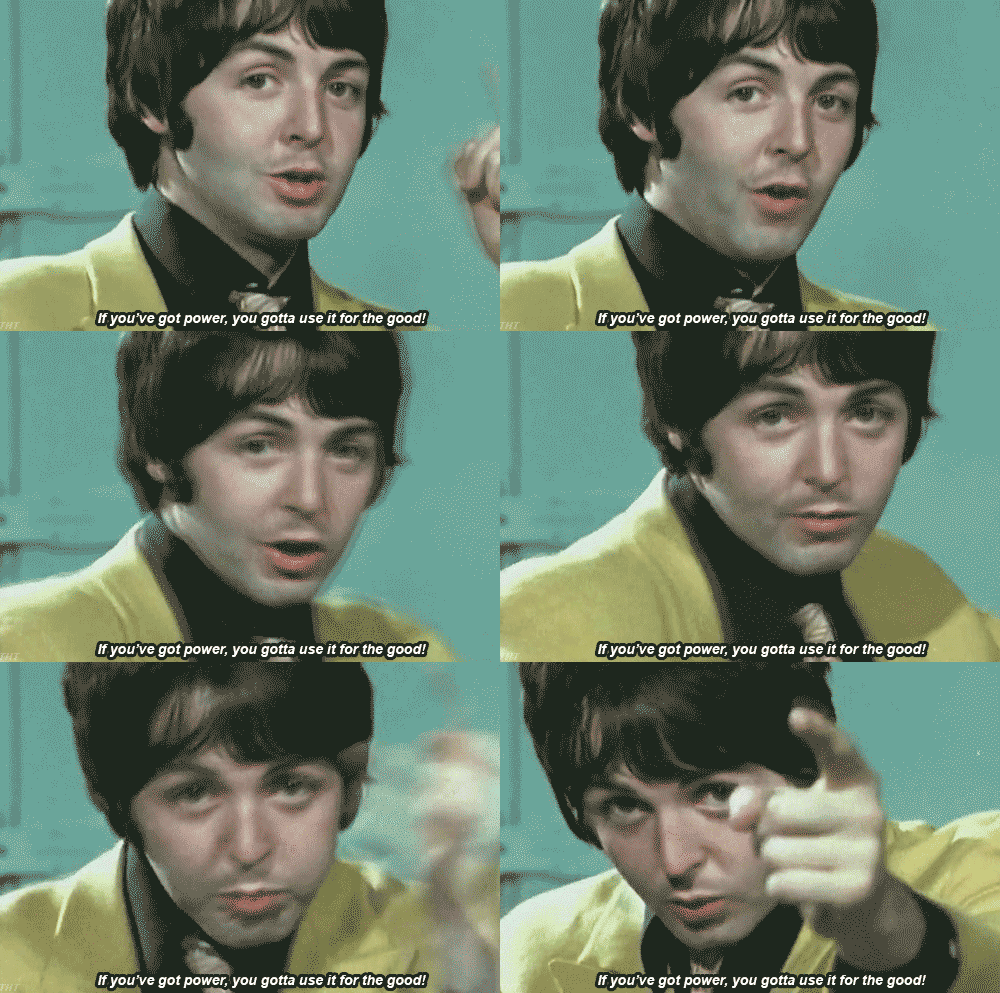 |
| Okay, so no one from Macbeth followed Paul McCartney's advice. |


This post is amazing! I think that your analysis is really good about Lady Macbeth and how her manipulation contributed to her power over Macbeth. Power is really interesting because it can lead people to be super greedy, and that is something we see today, even out of the fictional setting of Macbeth. So, I love how you scammed your little sister into giving you money because that is just so funny! I've always been on the receiving end of scams such as those so it's nice to know that there are older siblings out there who are scammers too! Represent!
ReplyDeleteI also did my post on the same quote, but I liked how you added the perspective of Lady Macbeth which I honestly did not even think about when I wrote mine. I think she is a great example of this quote as well and your analysis is spot on. I think it's so funny how you scammed your little sister into giving you money because I used to try and do the same to my brother.
ReplyDeleteGrace Copeland:
ReplyDelete1) STOP FREAKING TALKING ABOUT NEWSIES, WE GET IT
2) How do you write 3 paragraphs about a story we haven't read in like 3 months at this point?
3) "scammer" (OKAY Jonathon)
4) You're annoying and I'm tired.
5) Do you want to get salads again? (Without the broken foot part this time)
Yeah, let's get salads tomorrow. Do you still want to see that movie next Thursday? Because if so, I want to go to the theatre with the recliners, so we should preorder tickets.
DeleteAlso, great "analytical" comment, Grace. Mrs. Genesky, I would give her a zero if I were you.
DeleteI like how you included Lady Macbeth in the corruption of power too. When I was thinking through this, I only really thought of Macbeth himself, but you're right in that she used her power to manipulate (and it is definitely not healthy). I also like that you included a personal example, however incriminating it may be. :) It really shows how power can get to anyone's head and throw personal relationships out the window. (Not that that's what you did- it's what the Macbeths did, but I guess you could count too. Though in hindsight, a quarter isn't a huge deal. Anyway...)
ReplyDeleteI agree that Lady Macbeth was abusing the power she had over her husband. Even though she was doing it for him, the way she went about it was messed up. I didn't really think about how killing the guards tainted Macbeth even more because killing Duncan got rid of his hesitance in killing those that may stand in his way of the throne. This was a great post!
ReplyDeleteI like that you talk about the way that Macbeth abuses his power over the guards, and Lady Macbeth abuses her power over him. I think a good example of Lady Macbeth's corruption is when she is sleep walking and switching between comforting Macbeth and freaking out about her own role. She had power and abused it and she is paying the price for that through the corruption of her mental state.
ReplyDeleteThank you for your input
ReplyDelete